Good explanations.
Harder decisions.
Eight detailed hypothetical cases bring the pieces together. Follow the arithmetic, find the weak assumption and see what survives a less convenient outcome.
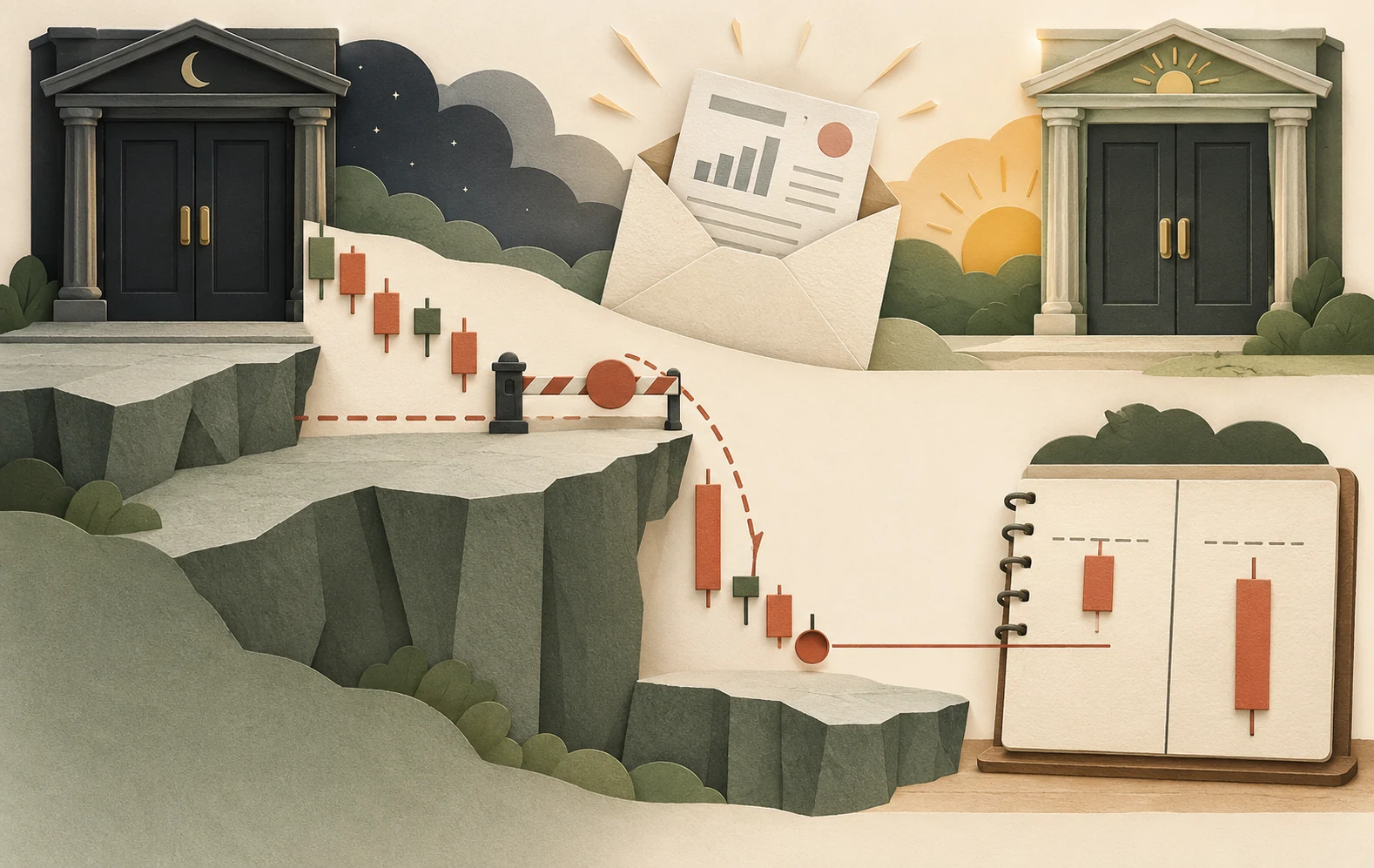
The stop that could not stop an earnings gap
A planned $250 loss becomes a $1,025 loss when the next executable price is nowhere near the trigger.
Work through the case ↗
The missing currency in a forex risk calculation
A yen-denominated loss must be converted into the account currency before a position can be sized.
Work through the case ↗
A correct thesis with the wrong funding clock
Short-sale arithmetic changes when price, borrow fees, and forced-close risk move against the trader together.
Work through the case ↗
One dollar on the screen is not one dollar in the bank
Separate token price, redemption access, and platform custody before treating a stablecoin balance as available cash.
Work through the case ↗
Fees earned, benchmark missed
A constant-product pool can rise in dollar value while underperforming the same tokens held outside the pool.
Work through the case ↗
Five positions, one underlying bet
Different tickers and asset classes can share the same vulnerability when liquidity disappears.
Work through the case ↗
The best backtest in the spreadsheet
Selecting the strongest of many experiments can manufacture confidence even when realistic execution erases the apparent edge.
Work through the case ↗
Profitable eventually, liquidated first
Variation losses and rising collateral requirements can exhaust available cash before a longer-term thesis is resolved.
Work through the case ↗Try it without
putting money at risk.
The workbook contains twelve shorter problems with worked answers. The journal gives you a place to record a thesis, an adverse scenario and what would change your mind.

Use each case twice, for different questions
On the first pass, hide the worked result and reconstruct the account: positions, price changes, costs and the timing of cash needs. Put the unit beside every figure. A correct final total reached by cancelling unrelated mistakes is not a reliable explanation. When your result differs, identify the first step at which the assumptions or arithmetic diverge.
On the second pass, change one assumption, not the whole story. Try a later settlement date, a worse executable price or unavailable collateral, and state which calculation must change. Keep the original answer beside the revised one. Distinguish a conditional numerical result from a forecast and from an action you would be authorised or able to carry out.