Normalized cash flow: separating a harvest from a habit
Determine whether apparently strong cash generation can continue without weakening the business.
Cash is observable; sustainability is estimated
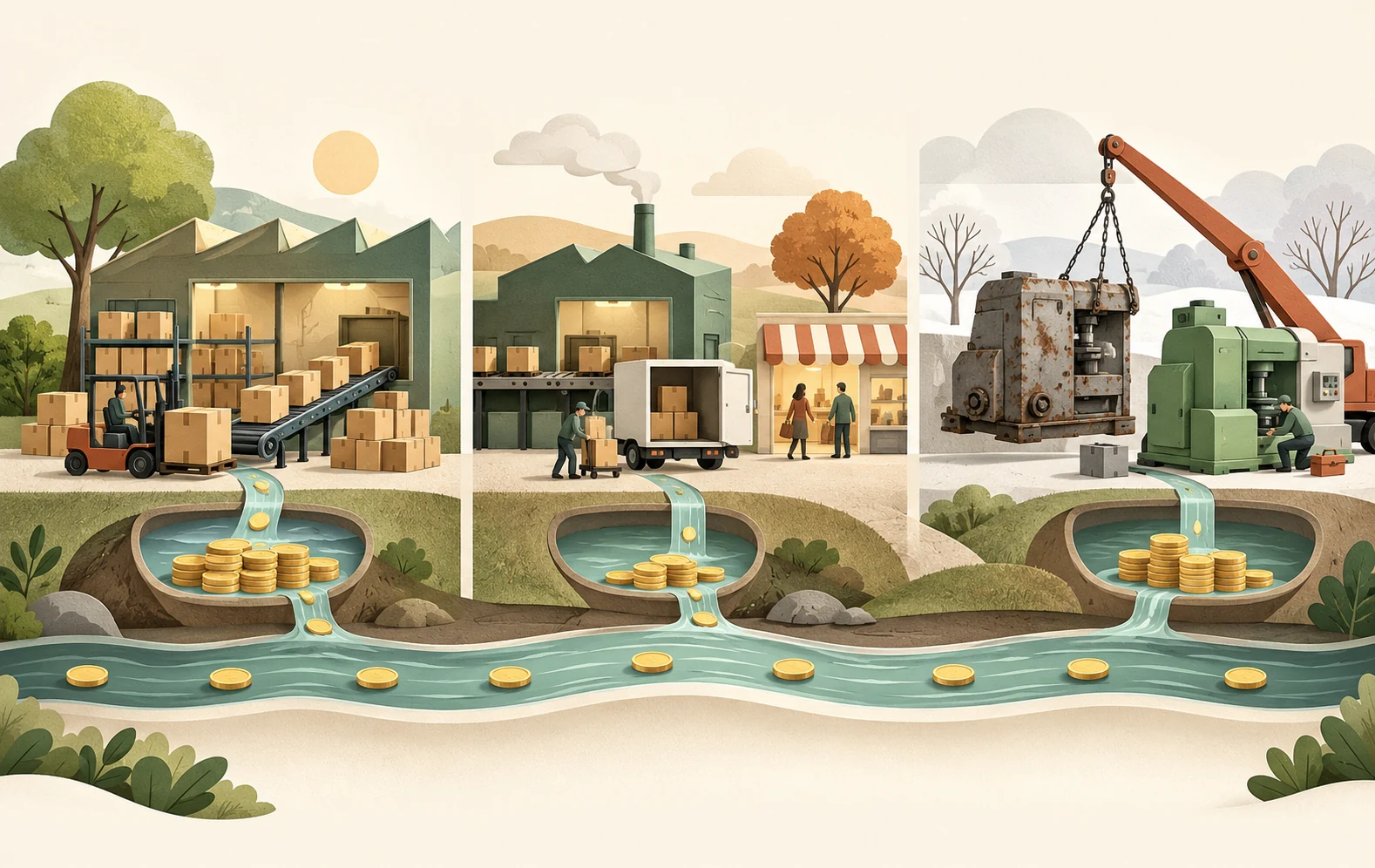
A strong cash-flow statement does not automatically imply a stronger franchise. Collecting overdue receivables, selling inventory and delaying supplier payments can release cash for a while. A shrinking business can generate substantial cash as it liquidates working capital, yet have fewer future customers and assets. Normalization asks which cash flows belong to a repeatable operating state and which arise from a transition.
Begin by specifying the measure. Operating cash flow less capital expenditure is a common free-cash-flow convention, but classifications and adjustments differ across companies and accounting frameworks. A measure after interest is not interchangeable with an unlevered cash flow before financing costs. Write the definition beside every number, especially when using it in a valuation denominator or comparing companies across jurisdictions.
Reconstruct working-capital economics
Connect receivables to customer payment timing, inventory to production and distribution requirements, and payables to supplier terms. Use average balances where practical and compare equivalent seasonal periods. A year-end collection push can flatter a single snapshot. Rapid growth often consumes working capital, while a subscription business receiving advance payments may initially generate it. Neither pattern is inherently superior without understanding margins, retention and obligations.
Model operating assumptions instead of mechanically adding back every working-capital outflow. If revenue expands permanently, some investment may remain necessary. If customers are paying later because their finances deteriorated, assuming an immediate reversal is optimistic. Supplier finance arrangements can also affect how the apparent funding cycle should be interpreted; examine disclosures and consider the economic borrowing involved rather than relying solely on the cash-flow classification.
Maintenance is an economic concept
Capital expenditure buys assets that serve multiple periods. Some spending preserves existing operations, while some supports expansion, compliance or strategic change. Companies do not always disclose a clean maintenance-versus-growth split, and management's estimate can depend on judgment. Treat the split as a range informed by capacity, asset age, depreciation, replacement prices and operational requirements rather than a precise observable fact.
Depreciation is not automatically maintenance spending. Historical-cost depreciation may understate current replacement costs during inflation, while a recently expanded asset base may depreciate faster than immediate replacement needs. Software development, leases and acquisitions introduce further comparability problems. A company that purchases small businesses instead of building capabilities internally may show attractive conventional free cash flow while repeatedly using cash elsewhere to sustain its competitive position.
Normalize without erasing inconvenient economics
Use a multi-year bridge with separate lines for reported cash flow, temporary working-capital effects, necessary investment and genuinely exceptional items. For each adjustment, describe the event that would reverse it and the period expected. A restructuring payment can be excluded from a steady-state illustration while still reducing actual cash available today. Keep those two perspectives visible rather than letting the adjusted series replace reality.
Cross-check the result against the business plan. Revenue growth without working-capital needs, capacity spending or employee investment may be plausible for some models but not for all. If a forecast simultaneously assumes faster growth, higher margins and lower investment, require a specific operational explanation. The most informative output is usually a range with identifiable drivers, not one normalized figure presented to the nearest decimal. Revisit the bridge as new disclosures arrive instead of treating normalization as a permanent license to remove costs.
Look for cash generation that depends on counterparties providing finance. Customer prepayments are helpful only while the business can fulfill its obligations profitably; they are not entirely free surplus. If new bookings slow while old contracts still require delivery, the cash pattern can reverse. A normalized forecast should model both the inflow from new commitments and the cost of servicing existing commitments, rather than extrapolating the recent net benefit indefinitely.
Watch a full operating cycle
A snapshot near a seasonal cash peak can make the balance sheet look more liquid than it is during the rest of the year. A fictional distributor might buy inventory in spring, sell it through summer and collect customers' balances in autumn. Its year-end cash position does not show the largest financing requirement that occurred before those collections. A normalized annual cash figure should be accompanied by a view of that within-year demand.
Suppose inventory falls by $20 million and receivables by $10 million during a wind-down, while suppliers are paid $8 million. Ignoring other movements, working capital releases $22 million of cash. Repeating that release indefinitely would require balances to keep falling, eventually beyond what the remaining business can support. The current cash receipt is real; the assumption that it can recur is the part that needs testing.
For a continuing operation, connect normalized balances to an operational scale. Ask how much inventory supports the expected sales mix, how long customers take to pay and what payment terms suppliers actually allow. A model that assumes both renewed growth and continuing inventory liquidation needs an explanation such as a demonstrably more efficient distribution system. Without one, the forecast is trying to spend the same working capital twice.
Replace the annual average with an asset schedule
Necessary capital spending often arrives unevenly. Imagine a fleet of machines that each lasts several years, with a large replacement program due in year three. The next two years may show strong cash flow because little replacement spending occurs, but treating that interval as a permanent run rate would omit the upcoming bill. An annual average can help describe steady-state economics; a dated schedule is still needed to understand liquidity.
Write down which assets are essential, their remaining useful capacity and the evidence for replacement costs. Where public disclosures do not support a detailed estimate, use a range and show what each end does to cash flow. Avoid replacing an uncertain estimate with depreciation simply because depreciation is easy to obtain. The accounting charge and the future purchase may be based on different prices, technologies and timing.
Then reconcile the schedule with the growth case. If the expansion forecast requires new equipment, the same spending should not disappear merely because the valuation also includes a maintenance allowance. If new equipment replaces old capacity and adds capacity at the same time, explain the overlap. The goal is a cash forecast that could fund the described business, rather than the highest free-cash-flow number a chosen definition can produce.